
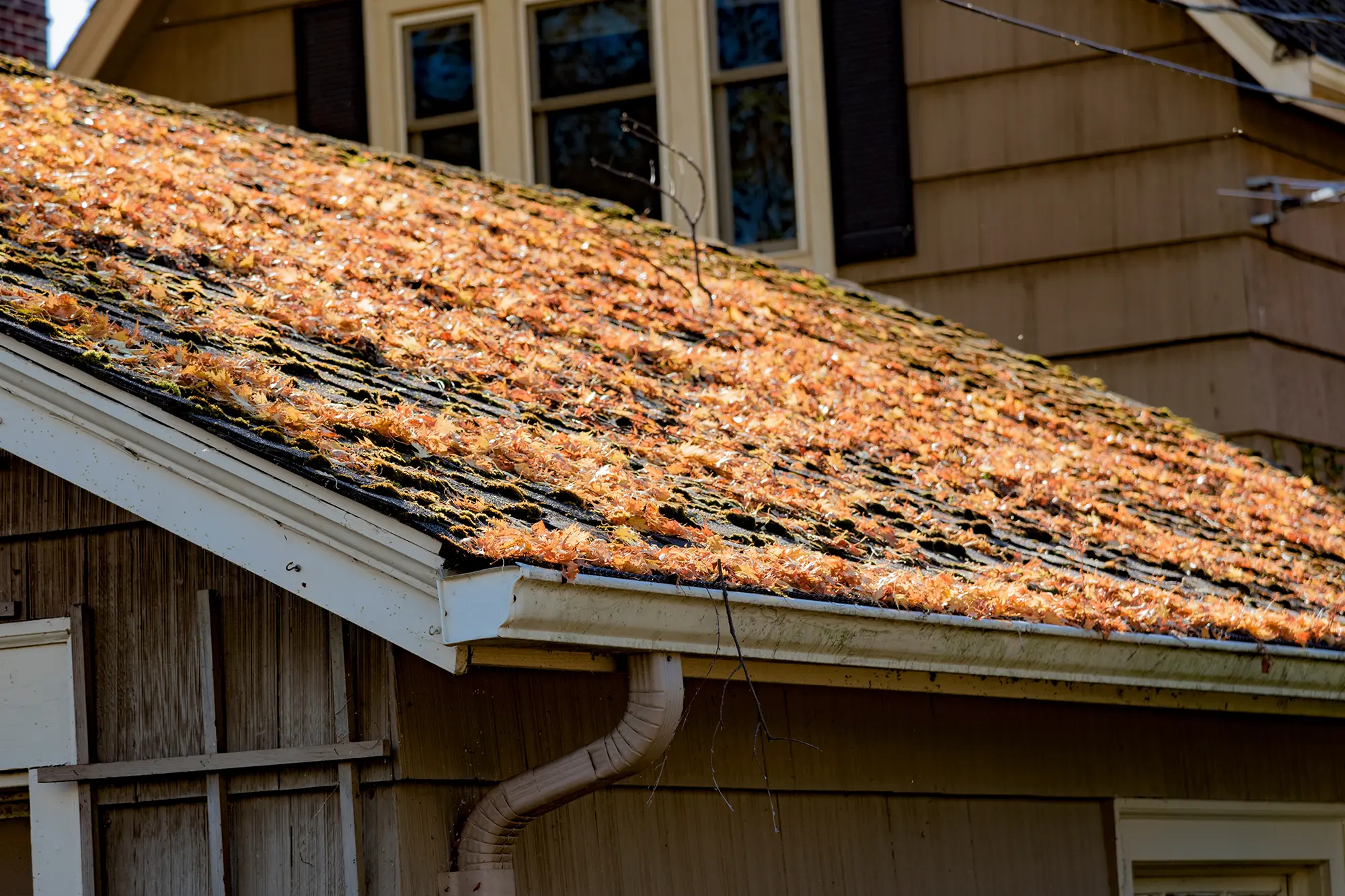
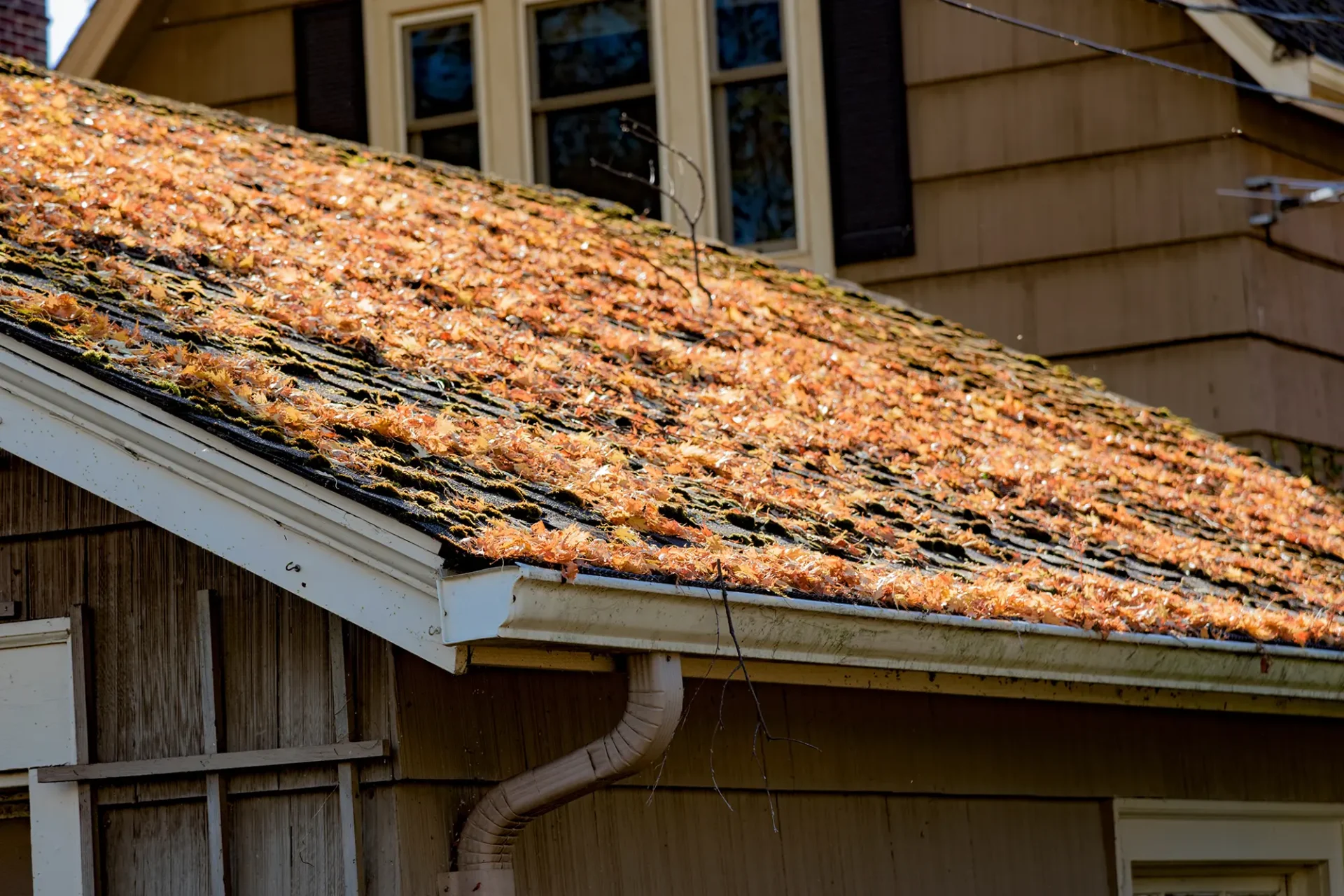
The usual advice is to clean gutters in spring and fall, and it assumes trees that drop their leaves in autumn. Houston’s most recognizable tree does it the other way around. Live oaks hold their leaves all winter and shed them in spring, so a house under a big live oak gets its heaviest gutter load in spring, often just after the gutters were cleaned for the season.
Under oaks, the useful schedule is set by what the trees around your house drop and when they drop it.
How much canopy one oak puts over a roof
Live oaks make up a small share of Houston’s trees and a much larger share of its canopy. The US Forest Service’s assessment of Houston’s urban forest found that live oak made up 2.0% of the city’s trees and 8.4% of its total leaf area (USDA Forest Service, Houston’s Urban Forest, 2015). Each tree carries roughly four times the leaf area its share of the tree count would suggest.
That spread is why a single mature live oak in the front yard can cover most of a roofline, and why gutters on the far side of the house from the trunk still fill up. Wind carries the small leaves across the roof, and they slide down the slope into whichever gutter sits below.
Live oaks shed in spring
NC State Extension describes the live oak as not a true evergreen: it keeps its leaves until the new ones appear and then drops the old ones (NC State Extension). The leaves are leathery and 2 to 5 inches long, small enough to slip into a gutter and stiff enough to stack into a dense layer once they are in it.
Louisiana State University’s horticulture notes put the timing on it. The old leaves turn brown and fall in early spring at the same time the tree flowers, and the species is known for tremendous pollen, acorn and leaf fall (Louisiana State University).
The flowering is the second half of the spring load. Texas A&M AgriLife describes oak flowers as worm-shaped male pollen tassels and notes that oaks flower in March and April (Texas A&M AgriLife Today). The Forest Service’s silvics manual gives live oak flowering a slightly wider window, from March through May (USDA Forest Service, Silvics of North America: Live Oak). The tassels come down over the same weeks as the old leaves, and the yellow pollen they shed coats the roof and washes into the gutters with the first rain.
The fall load from Houston’s other oaks
Live oaks are rarely the only oaks on the street. Water oaks are among Houston’s more common trees, and willow oaks are among its common large trees, according to the same Forest Service assessment. Willow oaks are deciduous, and the Texas A&M Forest Service’s tree planting guide notes that their leaves turn yellow-brown in fall before they drop (Texas A&M Forest Service, Texas Tree Planting Guide). A fall cleaning done before those narrow leaves have all come down misses many of them.
The Forest Service silvics manual gives willow oak acorns a maturing window from August to October (USDA Forest Service, Silvics of North America: Willow Oak), and its live oak entry says live oak acorns mature in September and fall before December. Acorns roll along the gutter toward the downspout outlet, which is the narrowest point in the system, and a handful of them wedged in the top elbow can stop a downspout completely.
A street with both kinds of oak therefore gives your gutters two distinct peaks:
- Spring, roughly March through May: live oak leaves and the pollen tassels from the oaks
- Fall: willow and water oak leaves, with acorns from late summer into late fall
Why oak debris is harder on gutters than other leaves
Live oak leaves are thick and waxy, and leaves like that break down slowly. The Lady Bird Johnson Wildflower Center’s article on leaf decomposition names Texas live oak (Quercus fusiformis), a close relative of the coastal live oak, among the trees with thick, dense or waxy leaves that can take the longest to break down (Lady Bird Johnson Wildflower Center). In a gutter that means the spring drop is still there, largely intact, when the fall leaves land on top of it.
Wet oak debris stains as well. Water that overflows a full gutter carries tannins from the leaves down the siding and onto the walks, leaving brown streaks that a garden hose will not remove. Once the gutters are clear, those streaks are a house washing job on the walls and a pressure washing job on the concrete below.
Where the debris collects
Oak debris does not spread evenly along a gutter run. The places that block first on a Houston house under oaks are:
- the inside corners below roof valleys, where leaves from two roof planes slide down and meet
- the run behind a chimney or a dormer, where the roof shape traps leaves before they reach the gutter and then releases them in a clump during heavy rain
- the downspout outlets, where acorns and leaf stems collect
- low-slope sections such as porch roofs, where leaves sit instead of sliding off
If you only have time to check part of the system after the spring drop, check those spots. A gutter can look clear along most of its length from the ground while the inside corner below a valley is packed solid.
Roof valleys hold debris of their own. A valley packed with oak leaves slows the water running down it, and in a heavy storm that water can back up under the edges of the shingles instead of reaching the gutter, so it is worth clearing the valleys at the same time as the gutters.
What a blocked gutter costs under an oak
A gutter that overflows in a Houston downpour drops the roof’s water in a line along the drip edge instead of carrying it to the downspouts. On a slab foundation, that line sits a foot or two from the slab. Over a season it washes the soil and mulch out of the bed below and splashes mud onto the lower siding, and it keeps that strip of ground soaked right against the foundation.
Water that runs behind the gutter instead of over the front soaks the fascia board, and fascia that stays wet through a Houston summer rots. A rotten fascia cannot hold gutter fasteners, so a cleaning problem turns into a carpentry job and then a gutter replacement.
When to schedule cleaning under oaks
There is no published frequency for gutter cleaning under oaks, and I would be wary of anyone who gives you a fixed number without seeing your trees. The more useful approach is to time each cleaning to come just after a debris peak, so the gutters are clear for the weeks that follow.
For a typical Houston house under one or more large oaks, the year looks like this:
- March and April: the live oak drop and the pollen tassels; let it happen
- Late April or May: the main spring cleaning, once the live oaks have their new leaves and the tassels are down
- June to September: a mid-season check on heavily shaded lots, ahead of the months when gutters carry the most storm water
- September to December: acorns and the fall leaves from deciduous oaks
- December: the second main cleaning, after the last of the fall leaves
Cleaning in early March, before the live oaks drop, is the most common timing mistake. The gutters look clear on the day, and they are full again a month later at the start of the spring storm season.
You can confirm the timing on your own house in a single rain. If water spills over the front lip of a gutter during an ordinary shower, or a downspout is barely flowing while the gutter above it is full, the system is blocked and needs cleaning whatever the calendar says. Our gutter cleaning visits include flushing every downspout, since acorns in the elbows are a common cause of exactly that symptom under oaks.
Gutter guards under oaks
Guards reduce how often gutters need a full clean under oaks, and they still need maintenance of their own. The University of California Agriculture and Natural Resources guidance on gutter guards was written for wildfire areas, where dry leaves in gutters are a fire risk (UC Agriculture and Natural Resources). It notes that there is no standard procedure for evaluating how well guards perform and that some products let debris build up on the roof behind the gutter, so guards need regular inspection.
Under oaks, a lot of the spring debris is small. If pollen tassels and leaf fragments collect on top of a guard, they can stop rainwater getting through and send it over the edge instead. If you fit guards, plan to have them checked and brushed off after the spring drop, and expect the gutter beneath to need an occasional clean anyway. Guards also make a blocked gutter harder to spot from the ground, so watching how the gutters behave in a heavy rain matters more once they are fitted.
Pruning: get the timing right
Cutting back branches that hang over the roof reduces how much debris lands in the gutters, and it keeps limbs off the shingles in a storm. With oaks in Texas, the timing of that pruning matters for the health of the tree.
The Texas A&M Forest Service advises that oak trees should not be pruned or wounded from February through June, when the fungal mats and the sap-feeding beetles that spread oak wilt are at their peak. It also says to paint any wound on an oak, whatever the time of year (Texas A&M Forest Service). Roofline pruning on Houston oaks is therefore best planned outside that February to June window. A gutter cleaning in December, after the fall leaves, is a good moment to look at which branches are worth having an arborist take back.
That timing applies to storm damage too. A limb torn off in an April storm leaves a wound during the risky months, and painting the torn surface follows the same Texas A&M Forest Service advice.
If you clean the gutters yourself
Oak debris is heavier and messier than it looks from the ground, and a few habits make the job safer and more effective:
- set the ladder on firm ground and never lean it on the gutter itself, which a full load of wet leaves has already strained
- scoop the debris out before using a hose, because flushing a gutter full of leaves pushes the mat into the downspout
- run water through every downspout at the end and watch the outlet, since acorns can sit in the elbow even when the trough looks clear
- bag the debris rather than leaving it on the lawn below, where tannins will stain concrete and pavers in the next rain
A two-story house under several mature oaks is a different job from a single-story ranch with one tree, and the steeper and higher the roofline, the more sense it makes to hand it over.
__________________________________________________
References
- USDA Forest Service, Houston’s Urban Forest, 2015 (Resource Bulletin SRS-211), https://www.srs.fs.usda.gov/pubs/rb/rb_srs211.pdf
- NC State Extension, Quercus virginiana, https://plants.ces.ncsu.edu/plants/quercus-virginiana/
- Louisiana State University, Department of Horticulture, Quercus virginiana, https://lsu.edu/departments/horticulture/plantmaterials/Plant%20Groups/Evergreen%20Trees/Quercus%20virginiana/index.htm
- Texas A&M AgriLife Today, oak pollen and flowering, https://agrilifetoday.tamu.edu/?p=307924
- USDA Forest Service, Silvics of North America: Quercus virginiana (Live Oak), https://www.srs.fs.usda.gov/pubs/misc/ag_654/volume_2/quercus/virginiana.htm
- Texas A&M Forest Service, Texas Tree Planting Guide: Willow Oak, https://texastreeplanting.tamu.edu/Display_Onetree.aspx?tid=85
- USDA Forest Service, Silvics of North America: Quercus phellos (Willow Oak), https://www.srs.fs.usda.gov/pubs/misc/ag_654/volume_2/quercus/phellos.htm
- Lady Bird Johnson Wildflower Center, The University of Texas at Austin, Breakdown: It’s Alright, https://www.wildflower.org/magazine/breakdown-its-alright
- University of California Agriculture and Natural Resources, gutter guards guidance, https://ucanr.edu/node/130462
- Texas A&M Forest Service, Oak Wilt Disease Threatens Texas Oaks in Spring, https://tfsweb.tamu.edu/oak-wilt-disease-threatens-texas-oaks-in-spring


