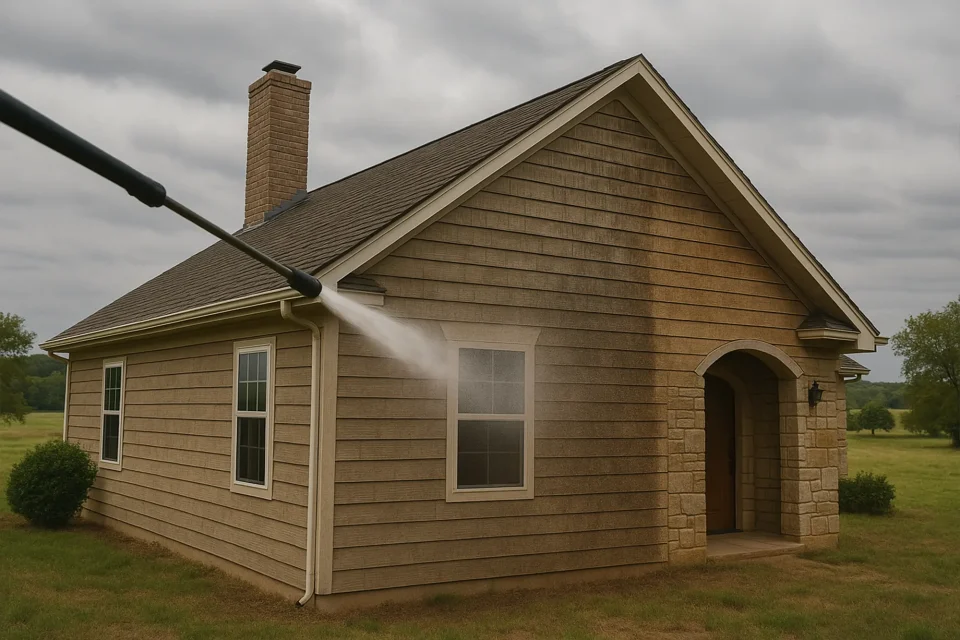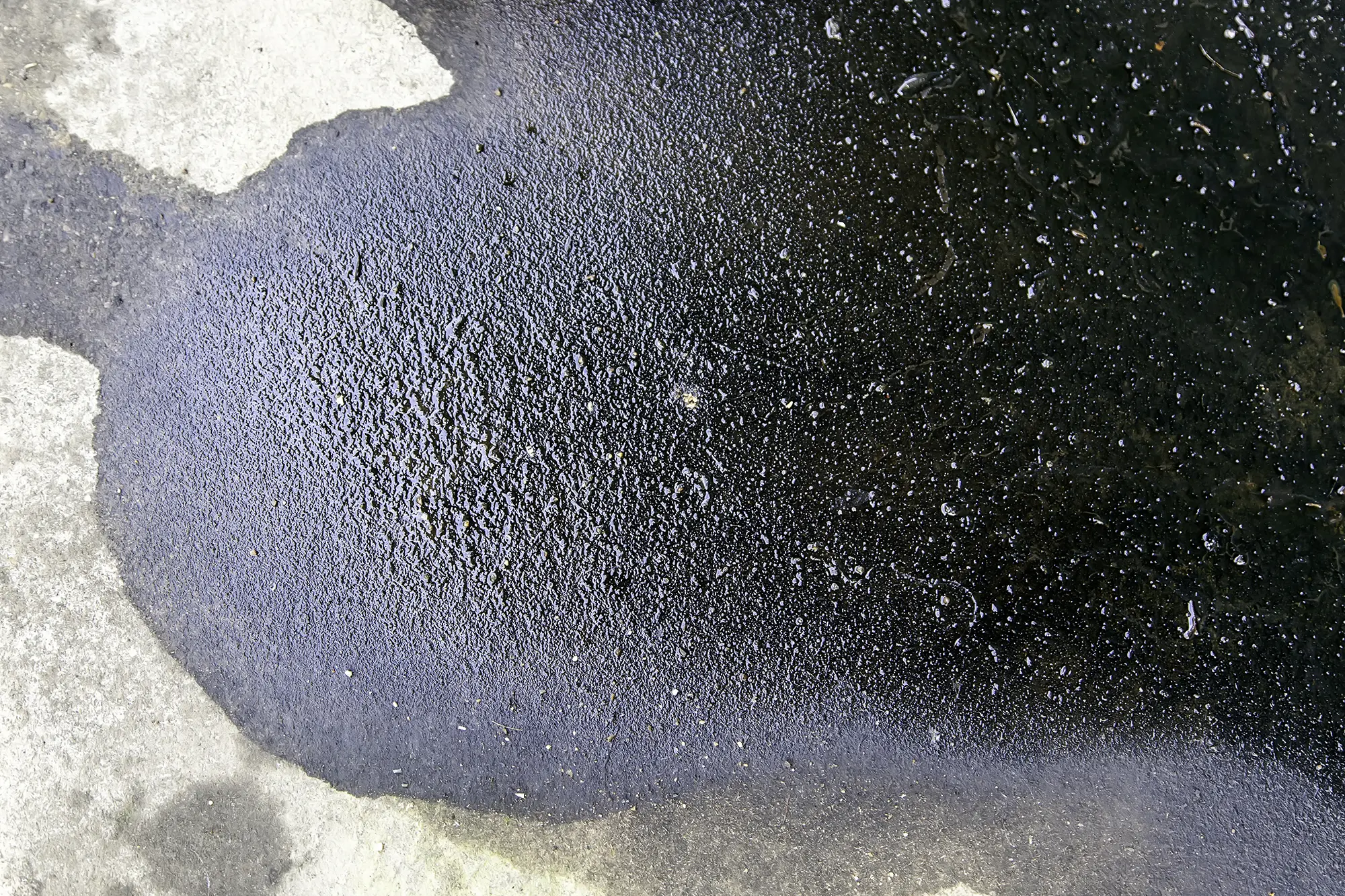
There is a moment most people have had on a Saturday morning. The driveway is coming up beautifully, the wand reaches the dark patch under where the car sits, and nothing much happens beyond a slight lightening. Then over the next week it darkens again and looks bigger than it did before you started.
The rest of the driveway is covered in surface soiling that pressure removes very well, which is why the same tool feels like it should work here. The oil patch is a different kind of problem, and it needs a completely different approach.
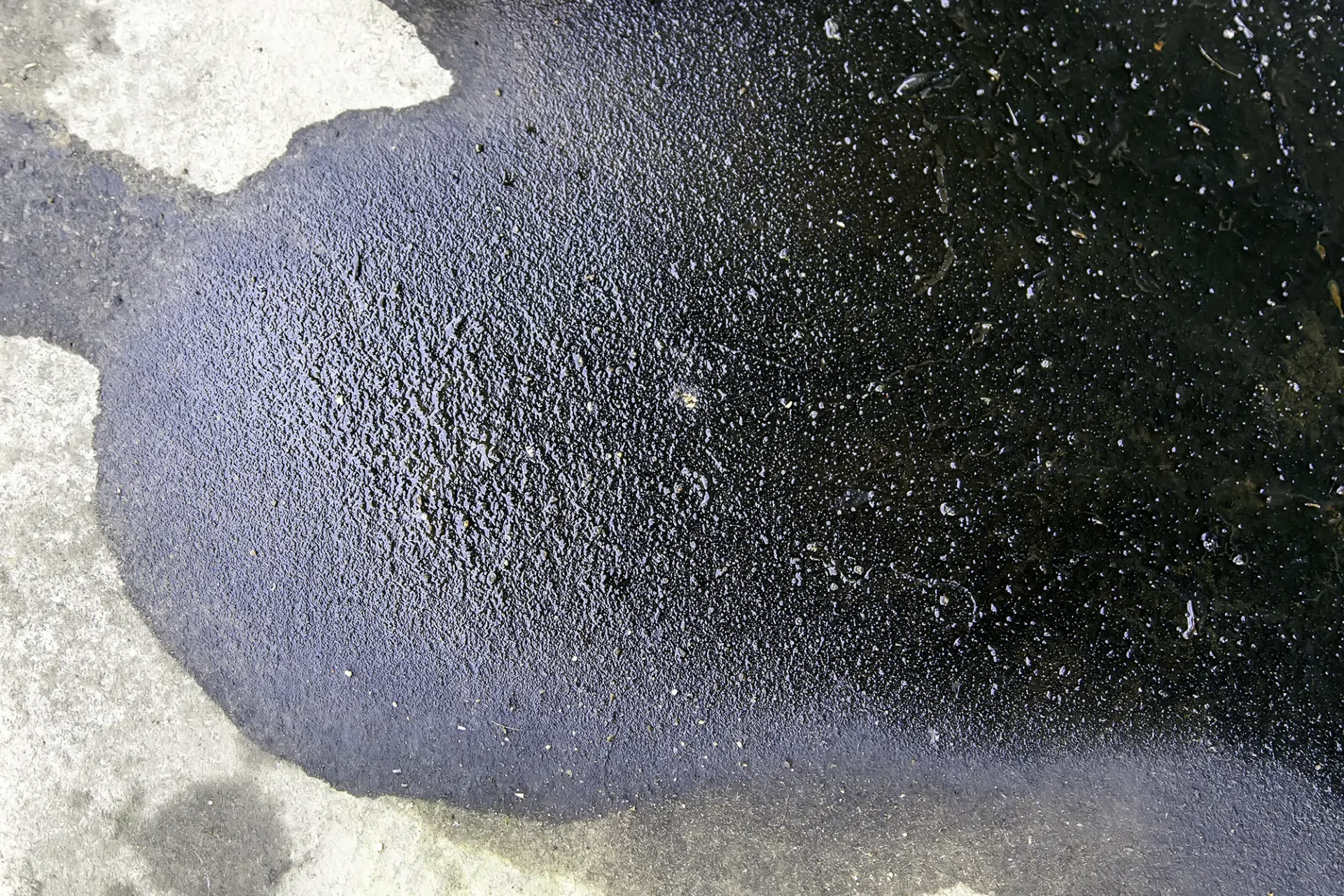
The oil is inside the concrete, not on it
This is the sentence the whole article hangs on, and it comes from people who clean stone for a living. The National Park Service draws the distinction directly: unlike particulate dirt, which tends to lie on the surface, stains are discolorations produced by foreign matter that has penetrated into, or permeated, the masonry (National Park Service).
A broom-finish Houston driveway is both porous and textured, which gives oil more surface to enter through and more places to sit once it is in. Once the oil is in the pore network, spraying water at it does two things, neither helpful. It pushes some of the oil deeper, and it carries the rest sideways across the slab, which is why the stain often looks larger afterwards.
Getting it out means reversing the direction of travel: dissolve or emulsify the oil, then pull it back up to the surface where it can be removed. That takes chemistry and time, and pressure is barely involved.
Dwell time does the work that pressure cannot
The products themselves give the game away, once you read what they ask for.
A concrete degreaser’s own technical data sheet calls for the solution to dwell 1 to 3 minutes, and separately calls 400 to 1,000 psi with a water flow rate of 6 to 8 gallons per minute the best pressure and water combination for rinsing porous concrete (PROSOCO Cleaner/Degreaser technical data sheet). What that describes is modest pressure and high flow, with minutes of contact time doing the actual work. It is a rinse specification for one product rather than a universal rule, but the shape of it is the point.
A poultice for a set stain asks for far longer. One manufacturer’s oil and grease poultice specifies a 5 to 8 hour dwell, after which you sweep up the dried poultice along with the contaminants it has absorbed (PROSOCO Oil and Grease Stain Remover). It also gives coverage at roughly 8 to 12 square feet per gallon, which is worth knowing before you buy: a two foot by three foot stain is most of a gallon.
Now compare that with a pressure washer wand, which spends perhaps two seconds passing over any given square inch. A degreaser wants nearly a hundred times that contact, and a poultice wants ten thousand times it. The tool everybody reaches for first is the one that supplies the least of what the job actually needs.
The poultice method, and what it is made of
A poultice is an absorbent powder mixed with a cleaning solution into a paste. The National Park Service lists the usual materials: inert clays such as kaolin or sepiolite, diatomaceous earth or fuller’s earth, or cellulose products like fluff pulp cellulose or shredded paper (National Park Service, Preservation Brief 38).
The mechanism is worth understanding, because it explains why patience is not optional. The paste holds the solvent against the concrete long enough to dissolve the oil down in the pores. Then, as the paste dries, it draws the dissolved oil up and out into itself. Remove the dried poultice and the oil leaves with it.
Which means the failure mode is peeling it off early. A poultice that has not dried has not done the second half of the job.
Deep or old stains often need more than one cycle. That is normal rather than a sign it is not working.
Fresh spills are a different job, and the first hour matters
If you catch it while it is still liquid, do not reach for a hose.
Absorb it dry instead, covering the spill and letting the material pull the liquid up rather than pushing it down. The EPA’s guidance on sorbents is useful for calibrating how much you need: natural inorganic sorbents, which it lists as clay, perlite, vermiculite, glass wool, sand or volcanic ash, can adsorb from 4 to 20 times their weight in oil, and natural organic sorbents between 3 and 15 times (US EPA). Cat litter is the household version of that first category, and it is genuinely effective on liquid oil.
What an absorbent will not do is pull a set stain back out of the pores, because it only catches what is still sitting on top, and that distinction gets lost in most of the advice online.
Driving the oil deeper is only half the reason to avoid the hose. EPA stormwater guidance on spill control is explicit about avoiding the use of water for cleaning, to prevent contaminated stormwater reaching storm drains (US EPA, Spill Prevention and Control Measures), so sweeping and absorbing first protects the storm sewer as well as your concrete.
Hot water, with an actual ceiling
Heat helps, and there is a real number attached rather than the invented ones you will find quoted around.
The National Park Service notes that the effectiveness of alkaline cleaners, particularly for removing paint, wax coatings, grease and oil stains, may be increased by a hot water rinse, and it caps that at not over 160 degrees Fahrenheit. The same source sets the governing principle for pressure: water pressure should always be kept at the lowest level that will clean without damage.
That pairing, warm water and gentle pressure, is the opposite of the instinct most people have, and it is why a professional hot water unit outperforms a bigger cold machine on this specific problem. Our driveway cleaning on oil-stained concrete runs heated water with a surface cleaner rather than a high-pressure wand, for exactly this reason.
What never to use
Solvents get suggested constantly for oil, and some of them genuinely do dissolve it, which is exactly why the hazards attached to them are worth spelling out.
The National Park Service warns plainly that organic solvents are toxic by ingestion, inhalation and skin contact, and that many are flammable or highly explosive in vapour or liquid form when mixed with air. That is not a theoretical caution on a hot Houston driveway with a car nearby.
For a sense of scale, mineral spirits, one of the tamer options, has a flash point of 102 to 110 degrees Fahrenheit, an OSHA permissible exposure limit of 500 ppm as an eight-hour average, and target organs listed as eyes, skin, respiratory system, central nervous system and kidneys (CDC NIOSH Pocket Guide to Chemical Hazards). A Houston driveway routinely exceeds that flash point on its surface in July.
Gasoline and brake cleaner both come up in DIY advice, and both are considerably worse than mineral spirits on every one of those measures.
Enzyme and microbial cleaners, honestly
These get marketed as the effortless answer, and they do work, on a timescale nobody mentions in the advertising.
The EPA and National Response Team fact sheet on bioremediation describes it as a relatively slow process, requiring weeks to months to effect cleanup, and notes it is not a primary response tool when free product is present or immediate cleanup is required (US EPA / National Response Team).
A timescale measured in weeks to months makes microbial products a reasonable finisher on light residual staining after the real work is done, and a poor choice as a rescue for a fresh puddle or a heavy old stain.
Where the oil goes afterwards
Two things worth saying, both easy and both routinely ignored.
Used motor oil is a serious water contaminant. The EPA puts it at a scale that surprises people: used oil from one oil change can contaminate one million gallons of fresh water, a year’s supply for 50 people (US EPA, Managing, Reusing, and Recycling Used Oil).
If you are changing your own oil, Houston takes it. The city’s guidance is that used motor oil is a contaminant of waterways, so do not pour it down a drain or put it in the trash, and it lists drop-off sites including the Consumer Recycling Center at 5900 Westpark at Fountainview, with a maximum of 5 gallons accepted (City of Houston Solid Waste Management).
The part most articles will not tell you
Some stains do not come out completely, and an old, heavy stain in aged concrete can leave a permanent shadow. The National Park Service acknowledges this directly for masonry, and concrete behaves the same way. What you can usually achieve is dramatic improvement rather than erasure, and how close you get depends mostly on how long the oil has been sitting and how porous and textured the slab is.
Anyone promising a guaranteed complete removal on a decade-old stain is selling you something. The honest sequence is to treat it properly, see where it lands after a couple of poultice cycles, and then decide whether the remaining shadow bothers you enough to consider a coating.
Sealing afterwards is worth a word too, because it is where people expect more than they get. Sealers vary in what they actually resist, and a plain water repellent is not an oil barrier; a product has to specifically claim oil resistance to provide it. Read the data sheet rather than the front of the tin, since “protects your driveway” covers a great deal of ground.
Whichever you use, the surface has to be genuinely clean and free of surface grease and oil before it goes down, or you seal the stain in permanently and remove your own ability to treat it later. That is the sequence to hold onto: degrease, clean, let it dry properly, then seal. Doing it in any other order locks in the problem.
It is also worth knowing that a sealed driveway does not stop needing attention, it just buys you time. Oil that lands on a sealed slab sits on the surface for far longer before it finds a way in, which turns a permanent stain into a wipe-up job if you get to it in the first day or two.
Fresh drips and light staining are a reasonable weekend job with an absorbent, a degreaser and patience. Set-in stains under a parking spot, a whole driveway that has been quietly collecting drips for years, or anything where you would rather not handle chemistry on a hot slab, is where pressure washing with heated water and the right pre-treatment earns its keep. And if the driveway is getting done, the runoff line down the house wall beside it usually needs attention at the same time.
__________________________________________________
References
- National Park Service, Keeping It Clean: Removing Exterior Dirt, Paint, Stains and Graffiti from Historic Masonry Buildings, https://www.nps.gov/orgs/1739/upload/book-keeping-it-clean.pdf
- National Park Service, Preservation Briefs 38: Removing Graffiti from Historic Masonry, https://www.nps.gov/orgs/1739/upload/preservation-brief-38-graffiti.pdf
- US EPA, Managing, Reusing, and Recycling Used Oil, https://www.epa.gov/recycle/managing-reusing-and-recycling-used-oil
- US EPA, Sorbents (Emergency Response), https://archive.epa.gov/emergencies/content/learning/web/html/sorbents.html
- US EPA and National Response Team, Bioremediation in Oil Spill Response fact sheet, https://www.epa.gov/sites/default/files/2013-07/documents/nrt_fact_sheet_bioremediation_in_oil_spill_response.pdf
- US EPA, Stormwater Best Management Practice: Spill Prevention and Control Measures, https://www.epa.gov/system/files/documents/2021-11/bmp-spill-prevention-and-control-measures.pdf
- US CDC, NIOSH Pocket Guide to Chemical Hazards, Stoddard solvent, https://www.cdc.gov/niosh/npg/npgd0569.html
- City of Houston Solid Waste Management Department, Motor Oil Disposal, https://www.houstontx.gov/solidwaste/motor_11252019.html
- PROSOCO, Oil and Grease Stain Remover product information, https://prosoco.com/product/oil-grease-stain-remover/
- PROSOCO, Cleaner/Degreaser Product Data Sheet, https://prosoco.com/Content/Documents/Product/PR_Cleaner_Degreaser_PDS_022018_C.pdf