A lot of the damage on stone patios is done while cleaning them, and on limestone and travertine the usual cause is acid. A homeowner tries vinegar on a stubborn mark, or a crew brings the muriatic acid they use on concrete, and a patio that was stained comes out dull and pitted instead. The General Services Administration, whose historic preservation program publishes technical procedures for federal buildings, makes the point in its guidance on sandstone: most damage occurs when attempting to clean the last 15% of dirt (US General Services Administration).
Getting a stone patio clean without that damage comes down to two questions you answer before any water goes on it: what stone is this, and what is the stain.
Know which stone you have
Patio stone falls into two groups for cleaning purposes, and the line between them is calcite.
Limestone, travertine and marble are made predominantly of calcite, a form of calcium carbonate, which the US Geological Survey notes is why these stones are vulnerable to acid (US Geological Survey). Travertine is a form of limestone, and the cream and walnut tiles around many Houston pools and outdoor kitchens are usually travertine, which puts them firmly in the group that etches.
Flagstone describes the shape of the stone, and it can be one of several rock types. The Museum of Fine Arts, Boston’s materials database defines it as a layered rock split into flat slabs, naming shale, bluestone, slate, quartzite and sandstone among the sources (Museum of Fine Arts, Boston, CAMEO). Most of those are more tolerant of cleaning chemicals than limestone. Sandstone is the exception, because some sandstones are bound together with calcite, and GSA’s sandstone guidance says acid cleaners should not be used on calcareous sandstone.
If you do not know what was laid, the Use Natural Stone program’s identification guide explains that calcite and dolomite stones react to acid, so a drop of something acidic such as vinegar will mark them (Use Natural Stone). Do that test on a leftover piece or an offcut, never on the patio itself, because a positive result is an etch mark. Installers often leave spare pieces in the garage or side yard, and that is the piece to test.
Etching needs a different fix from staining
The Natural Stone Institute’s stain guide states that etch marks are caused by acids and that some materials will etch the finish but not leave a stain (Natural Stone Institute). An etch is physical damage to the surface: the acid has dissolved a thin layer of calcite and left a dull, slightly rough patch that no cleaner will remove.
The Use Natural Stone program’s list of common cleaning mistakes says marble, travertine and limestone react with vinegar and other acids, and that the only fix for an etch is honing (Use Natural Stone, common mistakes). Honing means grinding the surface back with diamond abrasives until the damaged layer is gone, which is work for a stone restoration company.
Products to keep off calcite stone include:
- vinegar and lemon juice
- muriatic acid and other concrete or brick cleaners
- rust removers based on phosphoric or other strong acids, unless the label says they are safe on that stone
- general bathroom and tile cleaners that list an acid on the label
Identify the stain before choosing the cleaner
The same Natural Stone Institute guide says you need to identify the type of stain before you can remove it, and it groups stains by cause. The ones that turn up on Houston patios are:
- Organic stains from leaves, acorns, berries and bird droppings, which may leave a pinkish-brown mark. Live oak leaves sitting on a wet patio through spring leave exactly these marks.
- Oil stains from grills, cooking and sunscreen, which darken the stone.
- Rust stains, orange to brown, from metal furniture feet, planters or water running off metal above.
- Copper and bronze stains, green or muddy brown, from moisture acting on nearby copper, bronze or brass, such as light fixtures or flashing.
- Efflorescence, a white powder left when water carries salts out of the stone or the setting bed. Sweep or vacuum it off dry, without water, and find where the moisture is coming from.
- Biological growth such as algae, mildew, lichen or moss in shaded and damp areas.
Whatever the stain, never mix bleach and ammonia, because together they release a toxic gas.
Outdoors, once the source is removed, sun and rain will generally bleach organic stains out over time. A stubborn one on porous travertine or limestone can be treated with a poultice, which is an absorbent paste mixed with a cleaner suited to the stain, left to dry on the mark and draw it out.
Rust: fix the source before treating the stain
Rust is the stain that comes back if you only treat the stone. GSA’s procedure for poulticing rust stains from limestone and marble notes that the rust often comes from water running off metal flashing, gutters or fasteners above the stone, and that the source should be corrected before the stain is treated (US General Services Administration, rust poultice procedure). The poultice in that procedure stays on for about 48 hours.
On a Houston patio, the most common sources are metal patio furniture and a rusting gutter hanger or downspout strap that drips onto the paving. A blocked gutter that overflows onto the patio deposits whatever it carries, so if a rust line follows the drip edge of the roof, our gutter cleaning visit is the first step, and the stone comes second.
The rust removers that work fastest on concrete are usually acidic. On limestone or travertine, use a product labeled safe for calcite stone or leave the job to a stone restoration specialist.
Pressure, tips and distance
Stone does not need high pressure, and on soft stone high pressure does real harm. GSA’s guidelines for using high-pressure cleaning equipment on masonry put typical masonry cleaning at 500 to 1,000 psi and describe a low-pressure wash as 100 to 400 psi. For delicate surfaces they call for much lower pressures still, with a fan tip between 15 and 40 degrees, never narrower than 15, held 18 to 30 inches from the surface (US General Services Administration, high-pressure cleaning guidelines).
For patio stone I would stay within GSA’s low-pressure range and well below the typical masonry figure. A setting that is safe on dense quartzite will erode soft sandstone or open up the holes in unfilled travertine. Start low on a test area out of sight, and look at it once it has dried before you increase the pressure. Joint sand and mortar are usually the first thing to suffer, so watch the joints as much as the stone.
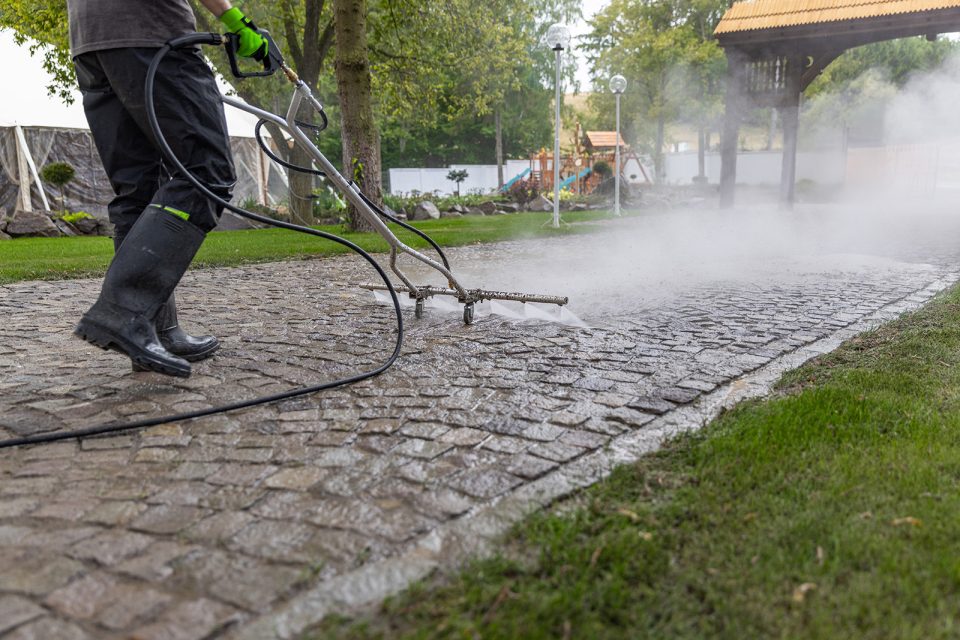
On our pressure washing jobs on stone, the cleaning is done mostly by the cleaner and the dwell time, with the pressure washer used as a rinse.
A practical sequence for a Houston stone patio:
- Clear furniture, planters and leaf litter, and dry-brush any white efflorescence.
- Identify the stone and test a small area out of sight.
- Apply a neutral or stone-specific cleaner and let it dwell as the label directs, keeping it wet in summer sun.
- Agitate with a soft or medium nylon brush.
- Rinse at low pressure with a wide fan tip held well back.
- Treat remaining individual stains with the right poultice once the patio is dry.
Choosing and checking a sealer
Sealing helps against stains, but it does not protect calcite stone from acid. The Use Natural Stone program’s guide to stone restoration states that sealers do not stop acid from etching (Use Natural Stone, restoration). A sealed travertine pool deck will still etch from a spilled margarita.
Outdoors, the type of sealer matters as much as whether you use one. PROSOCO, which makes masonry protection products, distinguishes penetrating treatments, which keep the stone breathable, from film-forming sealers that coat the surface. It recommends penetrating treatments for most exterior work, because film sealers that are not vapor-permeable can trap moisture and turn white, a defect called blushing (PROSOCO). Houston’s humidity, and the moisture that rises through patios set on a concrete slab, give a film sealer plenty of chances to trap water.
You can check whether an existing sealer is still working with the water test from the Use Natural Stone identification guide. Dribble a little water on the stone and leave it for 10 to 15 minutes. If the stone darkens, it has absorbed water, which on a sealed patio suggests the sealer is no longer working in that spot. Reseal only after a full clean and a dry spell, since sealing over dirt locks the dirt in.
Watch the concrete next to the stone
Many Houston stone patios sit against concrete, such as poured steps or a concrete pool coping. Concrete cleaners, including the muriatic acid washes used to brighten it, run downhill onto the stone next to it. The safer choice is a non-acidic concrete cleaner. If the concrete does need acid, soak the stone with water beforehand so it absorbs less of any splash, and rinse it again as soon as the concrete work is finished.
Grout and mortar joints need the same thought. Cement-based joints are attacked by acid as well, and an acid wash that dissolves the surface of the joints leaves them recessed and rough, which then collects dirt faster than before.
When to call a stone restoration specialist
Some patio problems are beyond cleaning, and a restoration specialist is the right call when:
- dull or rough patches stay the same after a thorough clean, which points to etching
- travertine has lost the fill from its holes over a large area
- the surface of the stone is flaking or crumbling
- a film sealer has gone cloudy and needs stripping before anything else can be done
The Use Natural Stone guide to restoration explains that a honed finish shows etching less than a polished one, which is worth knowing if you are refinishing an outdoor surface that will see wine and citrus spilled on it.
Houston conditions that change the routine
Shade and long humid spells give algae and mildew more time on stone here than in drier climates. A north-facing patio under live oaks can go green within a season, and it collects leaf and acorn stains through spring and fall on top. Patios like that do better with a gentle clean twice a year, since a hard clean every few years is the one most likely to damage the stone.
Oak leaves and pollen tassels left to sit through a wet spring are a common source of organic stains on light travertine. Sweeping or blowing the patio off every week or two through March and April prevents most of them.
If your stone patio sits next to a wood deck, the two usually get dirty together and are easiest to clean in one visit, with deck cleaning handled alongside the stone so the runoff from one surface does not re-stain the other.
__________________________________________________
References
- US General Services Administration, Removing Dirt Build-Up from Sandstone, https://www.gsa.gov/node/88388
- US Geological Survey, Acid Rain and Our Nation’s Capital: Stone, https://pubs.usgs.gov/gip/stones/acid-rain.html
- Museum of Fine Arts, Boston, CAMEO: Flagstone, https://cameo.mfa.org/wiki/Flagstone
- Use Natural Stone, How to Be Your Own Stone Sleuth, https://usenaturalstone.org/how-to-be-your-own-stone-sleuth/
- Natural Stone Institute, Stains, https://www.naturalstoneinstitute.org/consumers/stains/
- Use Natural Stone, 5 Common Mistakes to Avoid When Cleaning Natural Stone Surfaces, https://usenaturalstone.org/5-common-mistakes-avoid-cleaning-natural-stone-surfaces/
- US General Services Administration, Poulticing Rust Stains from Limestone and Marble, https://gsa.gov/real-estate/historic-preservation/historic-preservation-policy-tools/preservation-tools-resources/technical-procedures/poulticing-rust-stains-from-limestone-and-marble
- US General Services Administration, Guidelines for Using High Pressure Cleaning Equipment on Masonry, https://gsa.gov/real-estate/historic-preservation/historic-preservation-policy-tools/preservation-tools-resources/technical-procedures/guidelines-for-using-high-pressure-cleaning-equipment-on-masonry
- Use Natural Stone, What to Expect During a Natural Stone Restoration, https://usenaturalstone.org/what-to-expect-during-a-natural-stone-restoration/
- PROSOCO, Should I Use a Protective Treatment or Sealer?, https://prosoco.com/should-i-use-a-protective-treatment-or-sealer-whats-the-difference/