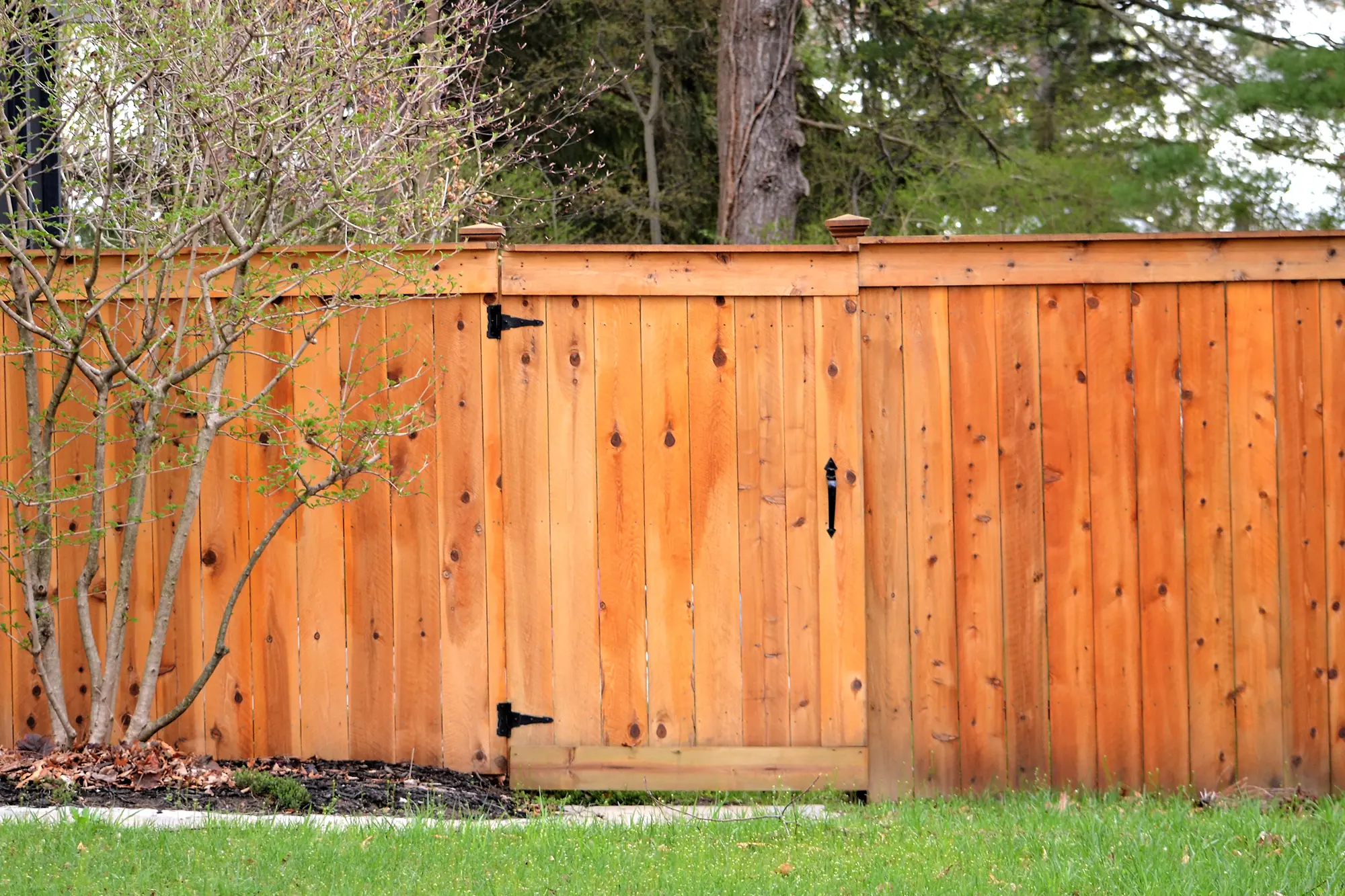
Almost every conversation I have about a gray cedar fence starts from the same wrong assumption: that gray means rotten, and the fence is on its way out.
In most cases the wood underneath is sound, because graying is a surface condition and a remarkably shallow one. Understanding how shallow it really is changes what you do about it, how much you spend, and whether you reach for a pressure washer at all.
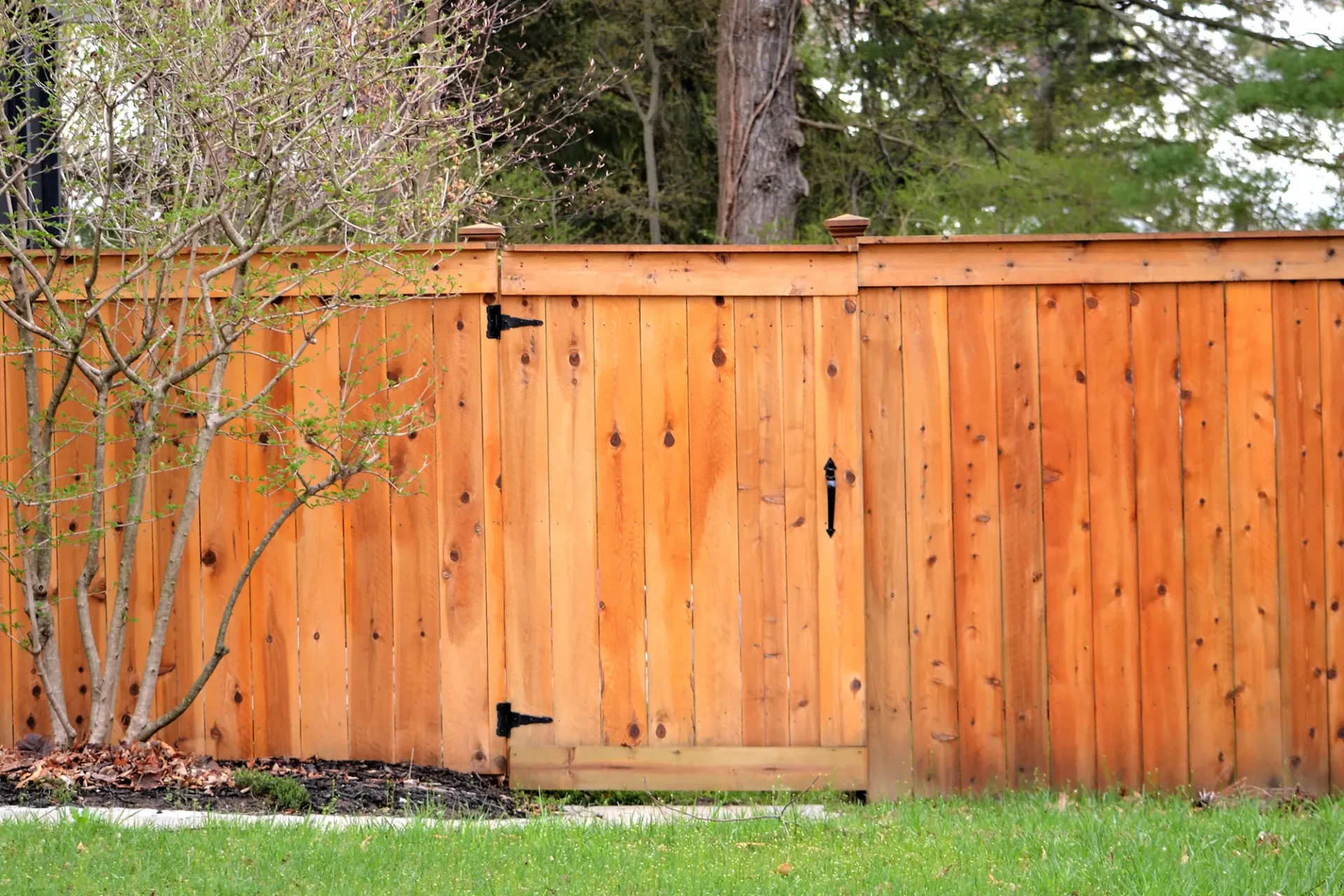
The gray layer is a few thousandths of an inch deep
USDA Forest Service research on exterior wood finishing describes the weathered gray layer as 3/1000 to 1/100 of an inch thick, made of loosely matted fibres of nearly pure cellulose, because rain leaches out the decomposed brown-coloured lignin and extractives (USDA Forest Service, Finishing Wood Exteriors). That is somewhere between three and ten thousandths of an inch, which is thinner than a sheet of paper.
Ultraviolet light breaks the lignin molecule so that it has no structural role and can be washed away, leaving cellulose fibres behind (USDA Forest Service, Forest Products Laboratory, Wood Handbook chapter 16). Lignin is the glue, cellulose is the fibre, and the sun removes the glue from the outermost layer only.
The wood itself disappears far more slowly than the colour suggests, at approximately a quarter of an inch lost in a century, with lower density wood eroding faster. What you are looking at on a gray fence is sunburn on a sound board.
That said, gray has a second cause worth separating out, and it changes what you buy.
Is it gray, dirt or mildew?
The Forest Products Laboratory notes that the gray surface colour of weathered wood usually results from the growth of microorganisms such as fungi or mildew, and mildew grows most extensively in warm humid climates. On the 1991 to 2020 normals, Houston averages 51.84 inches of rain a year at Bush Intercontinental with a mean annual temperature of 70.5 degrees (NOAA National Weather Service Houston/Galveston), which is about as hospitable to mildew as anywhere in the country.
There is a free test that settles it, and it comes from the same agency. Apply a drop or two of common household bleach solution to the stain, and mildew will usually bleach out in one or two minutes, where dirt and weathered gray will sit there unchanged (USDA Forest Products Laboratory, Research Note FPL-0128).
Run that test before you buy anything, because a fence that is mostly mildew needs a different product from one that is mostly UV gray, and most fences in this city are some of both.
Why the pressure washer is the wrong lead tool
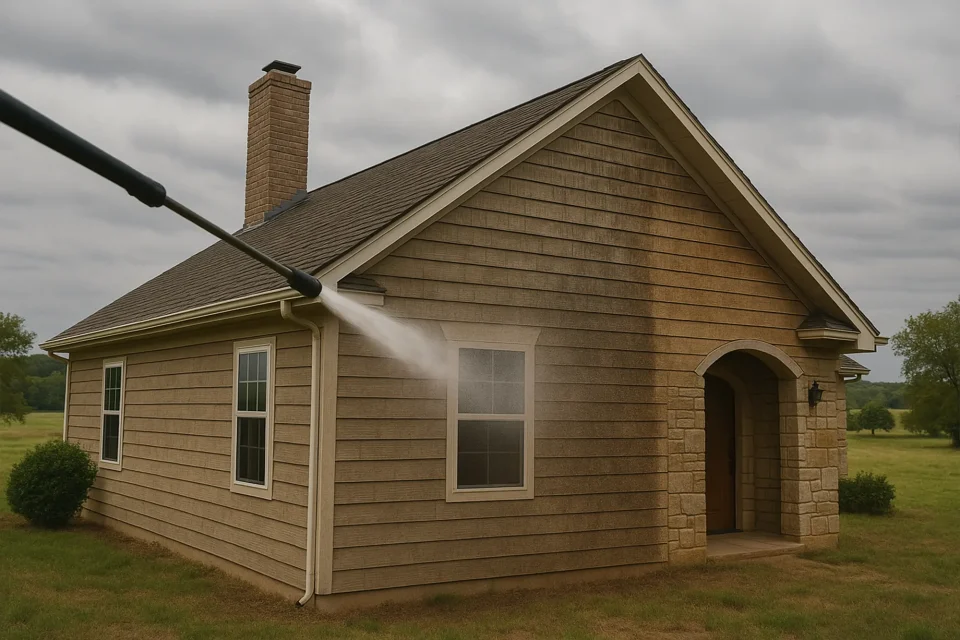
Cedar is soft, and it is built in alternating bands of soft earlywood and harder latewood. Hit it with enough pressure and the soft bands erode faster than the hard ones, leaving a raised, ridged, furry surface. The Wood Handbook names it directly, describing a washboard surface with raised latewood as a sign of weathering by sunburn or abrasion, such as sandblasting or aggressive power washing.
The Western Red Cedar Lumber Association is blunter: power washing should never be used for removing coatings from western red cedar, because the process can severely damage the wood surface fibres (Western Red Cedar Lumber Association).
I want to be careful here, because you will find confident PSI numbers quoted online for fence washing and none of them trace to a source worth citing. I am not going to invent one either. The defensible version is this: chemistry does the cleaning, water rinses it away, and the pressure should be the lowest that achieves the rinse, with a wide fan tip kept moving and kept back. A furred fence takes stain unevenly and looks worse after finishing than before, which is the expensive way to learn this.
That is the approach behind our fence cleaning, and it is why a cedar fence takes longer than the equivalent area of concrete.
What actually cleans it
The cleaner matters more than the machine, and the two common choices behave very differently.
Sodium percarbonate, sold as oxygen bleach, is the general answer. A joint coatings and forest products review hosted by the Forest Products Laboratory found sodium percarbonate based cleaners effective at removing dirt, mildew and weathered gray residues (Cleaners and Restorers for Wood Decks, USDA Forest Products Laboratory). One product, all three problems.
Chlorine bleach has narrower uses and real downsides. The same review warns that chlorine-based bleach products can do more harm than good, giving wood a whitish unnatural tone by bleaching out natural components, or fuzzing the surface by loosening small fibres. It adds a consequence most people never connect: if not rinsed properly, chlorine salt residues can cause premature graying of wood from the action of sunlight. Clean it with chlorine, rinse it badly, and you have accelerated the exact problem you were solving.
Oxalic acid is the specialist. It solubilises tannins and iron stains and renders them colourless, which is what you want for the black streaks bleeding from nails and hardware, and for restoring colour after cleaning. It is not as effective against mildew, so it is a second step rather than a substitute.
A practical sequence for a typical Houston cedar fence: percarbonate cleaner with dwell time, gentle rinse, then oxalic acid brightener where there is tannin or rust staining, then a thorough final rinse.
The number that decides whether your stain holds
If you take one actionable figure from this article, take this one.
Wood has to be dry enough before finish goes on. The Forest Products Laboratory puts the general target at 9 to 14 percent moisture content (USDA Forest Service, Wood Handbook chapter 15). Stain manufacturers publish their own limits: one exterior semi-transparent oil stain specifies 12 to 18 percent and says to wait 24 hours after pressure jet washing before applying (PPG, SICO Exterior Semi-Transparent Stain technical data sheet). Western Red Cedar Lumber Association says the moisture content cannot be above 20 percent. The Forest Products Laboratory’s older guidance is more conservative still, suggesting at least three warm, sunny days for adequate drying.
The ranges differ because products differ, and that is the real lesson. Read the can, and understand that a fence washed on Saturday morning and stained on Saturday afternoon has almost certainly failed this test regardless of which can you bought. A moisture meter costs very little and removes the guesswork.
Choosing the finish, with honest service life
This is where most money gets wasted, because the finish that looks best in the tin lasts the shortest time outdoors.
The Forest Products Laboratory publishes expected service life, and the pattern is consistent: water repellent preservative 1 to 3 years, semi-transparent penetrating stain 4 to 8 years, solid colour stain 6 to 15 years, and paint 10 to 20 years. Clear film finishes are the worst performers outdoors, needing refinishing every 1 to 2 years, because ultraviolet light passes straight through the clear film and degrades the wood underneath it.
Two adjustments to those numbers before you plan around them.
The Wood Handbook notes that if a finish is used on smooth wood, you should expect approximately half the service life compared with saw-textured surfaces, simply because more finish gets applied to textured wood. Most fence pickets have one rough face and one smooth face, and they will not weather at the same rate.
A fence also behaves differently from the wall of a house, because it gets sun on both sides at different times of day, and the west-facing side in Houston takes a beating the east side never sees. Plan on recoating unevenly, and on the sunny elevation coming due well before the shaded one.
For most cedar fences the right answer is a semi-transparent penetrating stain. A University of Wisconsin Extension guide on protecting wood fences puts the reason simply: semi-transparent stains soak into the wood without forming a film, so they will not crack or peel (University of Wisconsin Extension, Protecting Wood Fences for Yard and Garden). A finish that fails by fading is far easier to maintain than one that fails by peeling, because the prep for the next coat is a wash rather than a strip.
The Houston application window is narrower than you think
Product data sheets typically specify application between 50 and 90 degrees Fahrenheit with relative humidity at a maximum of 85 percent. Latex needs at least 50 degrees and oil at least 40.
Put that against a Houston July and the problem is obvious. Afternoon surface temperatures on a sun-facing fence run well above 90, and the humid mornings that bring the temperature down often sit above the humidity limit. Spring and autumn are when this work belongs, with mid to late morning on a dry day being the usable window in between.
New fences, and the mill glaze question
Two things are worth knowing about a fence that has just gone up.
The first is that leaving it bare through a Houston summer costs you before you have even started. The Wood Handbook reports that surface degradation of wood facing south for as little as one week prior to painting significantly shortened the service life of paint, and explains why: UV-degraded cells on the wood surface may adhere extremely well to the applied finish, but they do not hold well to the wood underneath. You end up with a finish bonded to a layer that is itself letting go.
The second is mill glaze, the thing contractors argue about endlessly, where the Forest Products Laboratory tried to reproduce it and could not. Their report states that they have been unable to obtain a glazed surface, and that in all cases, finish failures were readily explained by other mechanisms including raised grain, UV degradation before painting, insufficient coating thickness, poor surface preparation and moisture problems (USDA Forest Products Laboratory, Mill Glaze: Myth or Reality?). If a finish failed, look at those five causes rather than at a glaze nobody can produce in a laboratory.
If the wood is already sunburned, there is a remedy with a number attached. The Wood Handbook suggests sanding off about 100 micrometres, which is 0.004 of an inch, and repeating the adhesion test.
Where the real failure happens
The gray surface draws all the attention, and it is almost never where a fence actually gives up.
The posts are where it happens, because decay is most severe at the groundline where moisture from the soil mixes with oxygen from the air, which is why pressure treated pine posts rated for ground contact are specified to last 30 to 40 years anywhere in the United States while the pickets above them weather cosmetically for decades.
So when you are deciding whether a fence is worth restoring, push on the posts at ground level before you look at the colour of the boards. Sound posts under gray pickets means you have a cleaning and staining job in front of you, and soft posts under beautiful pickets means you are having a different conversation altogether.
Cleaning a short run of fence yourself with a percarbonate cleaner, a soft brush and a garden hose is a perfectly reasonable weekend. Where it usually makes sense to hand over is a long run, a fence that has already been furred by a previous wash, or a job where the staining has to follow the cleaning inside a narrow weather window. That is the work our fence and exterior pressure washing crews schedule as a two-stage visit, and it often pairs with a house wash since the same shaded, humid conditions that gray a fence are working on the walls behind it.
__________________________________________________
References
- USDA Forest Service, Finishing Wood Exteriors, Agriculture Handbook 647, https://www.fpl.fs.usda.gov/documnts/usda/ah647.pdf
- USDA Forest Service, Forest Products Laboratory, Wood Handbook chapter 16, Finishing of Wood, FPL-GTR-282, https://www.fpl.fs.usda.gov/documnts/fplgtr/fplgtr282/chapter_16_fpl_gtr282.pdf
- USDA Forest Service, Forest Products Laboratory, Wood Handbook chapter 15, Finishing of Wood, FPL-GTR-113, https://www.fpl.fs.usda.gov/documnts/fplgtr/fplgtr113/ch15.pdf
- USDA Forest Products Laboratory, Research Note FPL-0128, Wood Finishing: Mildew on House Paints, https://www.fpl.fs.usda.gov/documnts/fplrn/fplrn128.pdf
- Joint Coatings/Forest Products Committee, Cleaners and Restorers for Wood Decks, hosted by USDA Forest Products Laboratory, https://www.fpl.fs.usda.gov/documnts/pdf1998/ross98e.pdf
- USDA Forest Products Laboratory, Mill Glaze: Myth or Reality?, https://www.fpl.fs.usda.gov/documnts/finlines/finishline_mknaebe_2013_007.pdf
- University of Wisconsin Extension, A3052, Protecting Wood Fences for Yard and Garden, https://www.fpl.fs.usda.gov/documnts/pdf1979/degro79a.pdf
- Western Red Cedar Lumber Association, Paint or Stain Cedar Siding? How to Finish Western Red Cedar, https://www.realcedar.com/siding/finishing
- PPG Architectural Coatings, SICO Exterior Semi-Transparent Stain for Wood, technical data sheet, https://ppcdatasheets.z20.web.core.windows.net/TDS/TDS_00400218_EN_CA.pdf
- NOAA National Weather Service Houston/Galveston, Houston IAH Extremes, Normals, and Annual Summaries (1991-2020 normals), https://www.weather.gov/hgx/climate_iah_normals_summary